
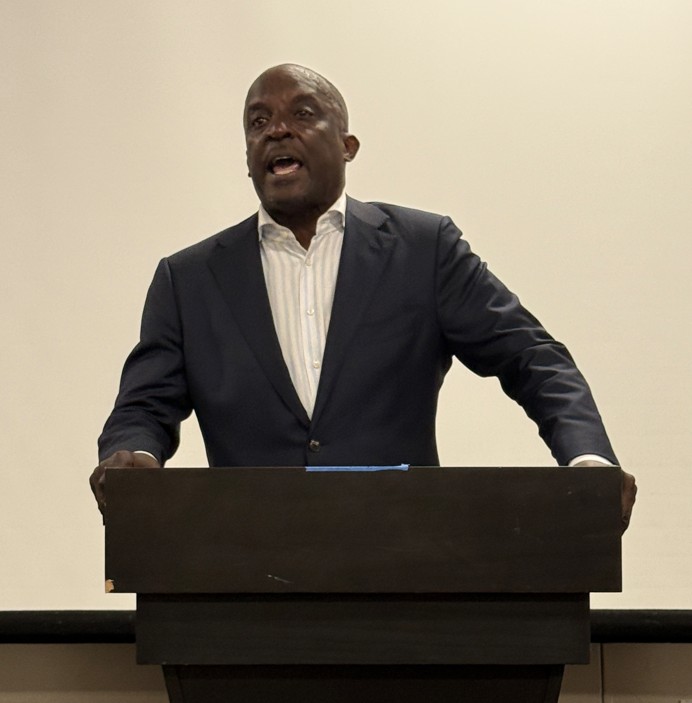
Good morning everyone. Thank you to Linda Monteiro, Gillian Hinkson, Charlotte Golar Ritchie, and all the members of the Committee for inviting me here today.
For those of you who don’t know me, my name is Ron Bell, and for the past five decades, I’ve been on the ground, in Boston, around the Commonwealth, and beyond, fighting this great fight for justice and equality.
Now, I’m not afraid to date myself like that, because today I want to take a look at where we are, compared to where we have been, so we can talk about what we need to do now, to get to where we need to go.
In 1992, I started Dunk the Vote as a response to what happened in Boston’s Black community in the aftermath of the Stewart Case.
37 years later, and we’re still talking about the same problems – widespread discord in the relationship between law enforcement and Black people. Between law enforcement and immigrant communities.
When Stephenson King, a Dorchester resident, was shot dead by a Boston Police Officer just two months ago, I had to wonder, along with many in the community, what progress have we really made. And when nine Allston Car Wash workers were chained up and taken away by over 20 masked I.C.E. agents, without even being given the chance to show their immigration paperwork, I found myself wondering, what have we gotten so wrong that our friends and neighbors have to suffer these blatant and violent civil rights violations.Back in 1992 we used to give out racial profiling packets made by the ACLU to folks traveling through the town of Milton because it had the highest rate of racial profiling traffic stops in the Commonwealth. Today, that is no longer the case in Milton. That campaign, combined with many other parallel efforts, made a big difference.
In 2026, Dunk the Vote is connecting the most at-risk among us with another tool to navigate today’s fraught environment. The Black Book. This is a resource. It is an implement that is transferable, convenient, and durable. It contains vital information on knowing your rights, and resources to help when they are violated. It covers the key areas of Civil Rights, Voting Rights, Immigrant Rights, Racial Profiling, and Police Brutality. And its most important quality is that it is accessible to the people who need it most. It meets people where they are at.
I want to re-emphasize that last piece. Meeting people where they are at, on their own terms.
If there is anything you take away from here today, I want it to be that. Because that’s how you win.
It’s how we did it on Deval Patrick’s campaign when I was a senior advisor and we put him in the Governor’s office in back-to-back elections.
It’s how we did it when we put my cousin Tito Jackson on the City Council twice.
And for Julia Mejia’s campaigns for City Council, when we won, both years…guess what. We got out in the neighborhoods, in the barber shops, we knocked on doors. We met people where they were at.
And in the historic election of President Barack Obama in 2008, we teamed up with now-United States Congresswoman Ayanna Pressley to reach out directly to Black churches to get out the vote.
So, the question is, in the face of all that lies in front of us, with so much division, opposition, and confusion, what do we do?
My answer to that question isn’t complicated, and it isn’t flashy. But it does take commitment. And it takes resources. And it takes a long term commitment. Because you have to show people that you’re real, and that the work is real.
Build an on-the-ground organization like we did in 2006 and 2010, in 2011 and 2013, in 2019 and 2021. Invest in people. PAY your people. Volunteers are great, but for reliable results you can’t expect people to work for free. Especially when they are pounding the pavement and knocking on doors all through the year. Yes that’s right, the whole year.
This July, Dunk the Vote is starting its Get Out the Vote campaign months before anyone casts a ballot – we’re not waiting until November or September. Because the impact you make by being there year-round, and not just when it’s election season, is on an entirely different level. And in today’s environment, trust is at an all-time premium.
We’re meeting people where they are at. Talking about the issues that matter most to them. On their timeline.
I’m sure you know this, but people are leaving Massachusetts at a higher rate than any other state in the union. That’s dead last, 50 out of 50.
Over the past 4 years, an organization I co-founded called Real Talk held conversations with hundreds of people across the Commonwealth whose voices aren’t the loudest at the decision-making tables. We used cutting edge technology to process and parse these conversations. And one thing came out as by far the dominant concern.
What do you think it was? I’ll tell you, it’s the same reason young people are giving for leaving the state.
I will tell you this – if we aren’t out in the neighborhoods, in the barber shops, on college campuses, in the churches, in the community centers, talking to people about our solutions to the fact that no one can afford anything in this state, then we’re making a huge mistake.
It is time to hold Real Talk-style conversations with people to make sure they feel heard, to learn directly from them what it is they care about. We need to be sharing our solutions and our resources with people who need them. This is how we engage new people, and it’s how we bring people back to the party. We need to rebuild relationships, and it needs to both be and feel grassroots. It’s the same playbook Dunk the Vote used to register over 100,000 voters over three decades of basketball tournaments, door-knocking, and one-on-one conversations.
Instagram posts are seen once and then scrolled by. The Black Book stays in your pocket. A text message is sent to the spam folder. A knock on the door is an opportunity to have a real dialogue.
In today’s America, the same rules do not apply to everyone. You can storm the Capitol and get rewarded with a $1.8 billion dollar slush fund for breaking the law. You can lose your voter protections with the drop of a gavel. Which is why we need to build our network, without shortcuts.
It is time that we put away our phones, lace up our Adidas, and get out on the doors.
Massachusetts is a cold state. And I’m not talking about the weather. People aren’t talking to each other. People are leaving.
That’s an opportunity.
We connect with people directly. We expand the tent. We keep people here by making it affordable. We give people the real resources they need to be safe. These are the issues of the people the party has a hard time reaching – young people, Black, Latino and underserved communities.
We build out the ground-game. We fund our teams year-round, to develop relationships and the trusted leaders of tomorrow. We hit the ground, now. We meet people where they are at. We make the network strong and resilient. And then, we follow up. Again and again. Until we win.